


A “stronghold” attracting high-quality FDI flows.
The return of a multi-billion dollar high-tech project demonstrates that Vietnam’s selective approach to attracting foreign direct investment (FDI), prioritizing advanced technology projects with high added value, is a sound policy that is proving effective.
The billion-dollar project is back.
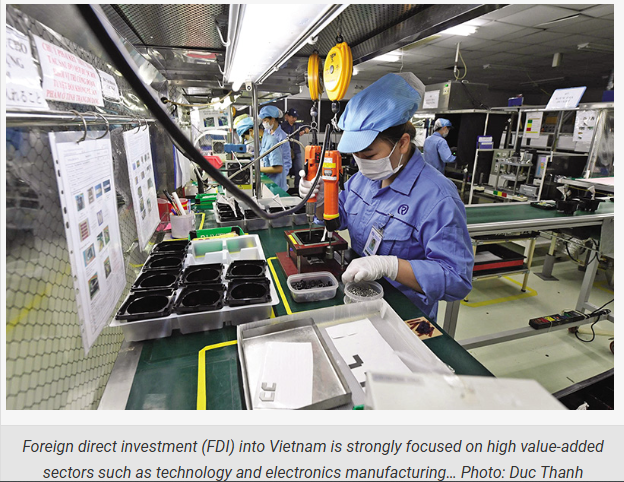
A notable point in the report on FDI attraction in the first two months of 2026 is the return of a multi-billion dollar project . A high-tech project specializing in the production of high-end electronic circuit boards has been granted an investment registration certificate , with a registered capital of 1.2 billion USD.
Commenting on this move, the Foreign Investment Agency (Ministry of Finance ) stated that this is a “bright spot” in attracting large-scale high-tech projects. “The implementation of this project demonstrates Vietnam’s selective FDI attraction strategy, prioritizing advanced technology projects with high added value and the ability to link with the domestic business sector ,” said a leader of the Foreign Investment Agency.
Thanks to the aforementioned multi-billion dollar project, the total registered FDI capital in the first two months of 2026 reached over $6 billion. Although still down 12.6% compared to the same period last year, this is a fairly positive figure given the geopolitical tensions in the Middle East and other regions, as well as the volatile trade and tariff policies of some major economies , which have created an unstable international investment and trade environment.
In the current context, many multinational corporations are tending to adjust their investment strategies towards greater caution, prioritizing the optimization of existing supply chains and reassessing plans for overseas investment expansion. However, the restructuring of supply chains in the Asia-Pacific region continues, with Vietnam still considered an attractive destination due to its stable political environment, extensive network of free trade agreements, and favorable position in the regional production chain.
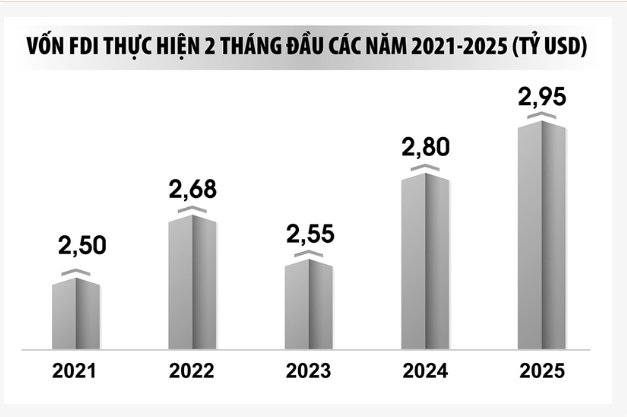
That’s why billion-dollar projects are still returning. The trend is also becoming increasingly positive, as according to the Foreign Investment Agency, the registered FDI capital figure for February 2026 (US$3.43 billion) was 34% higher than the US$2.57 billion of January 2026. In this context, disbursed capital continues to maintain positive growth, estimated at over US$3.2 billion, an increase of 8.8% compared to the same period.
“This is a positive sign in the context of a more cautious trend in global FDI flows. This result shows that existing investment projects continue to be implemented on schedule and expand production and business activities, reflecting the confidence of foreign investors in the investment and business environment in Vietnam. Maintaining the disbursement growth rate also contributes to strengthening the role of the FDI sector in the production and export activities of the economy,” the Foreign Investment Agency commented.
Mr. Nguyen Bich Lam, former Director General of the General Statistics Office, also acknowledged this. According to him, the disbursement of FDI capital reaching over 3.2 billion USD – the highest level for the first two months of the year in the past five years – is a signal that the capital flow is not just at the commitment stage, but is actually being disbursed. He called this a “bright spot” for the economy.
At the Government’s regular meeting in February 2026, Minister of Finance Nguyen Van Thang also emphasized this point and affirmed that it is one of the positive results that the economy has achieved.
The FDI attraction picture for the first two months of the year shows a more positive trend. However, frankly, the Foreign Investment Agency also mentioned that investments through capital contributions, share purchases, and additional investments continued to decline, reaching $499.4 million (down 5.7%) and $1.9 billion (down 52.3%) respectively compared to the same period last year, highlighting the difficulties in attracting FDI. Not only are the scale of new projects generally small and medium, indicating that investors are still in a exploratory phase, gradually expanding rather than committing to large-scale projects from the outset, but existing investors are also more cautious in expanding their investments amidst the volatile global economic outlook.
“The bright future still lies ahead.”
Despite the significant challenges ahead, Vietnam’s prospects for attracting FDI remain bright. The continued increase in disbursed capital and the rise in the number of new projects demonstrate that foreign investors maintain long-term confidence in Vietnam’s investment environment. Furthermore, recent statements from foreign investors indicate that Vietnam continues to be an attractive destination.
Perhaps it is no coincidence that GE Vernova (USA) decided to choose Vietnam as the first Asian country to host its annual Energy Conference – Shaping the Future of Energy, bringing together more than 100 leaders from leading global energy corporations, thereby marking the beginning of a new phase of development in GE Vernova’s cooperation with Vietnam and the region.
During a recent meeting with General Secretary To Lam, Scott Strazik, President and CEO of GE Vernova, stated that after more than 30 years of operation in Vietnam, GE Vernova is ready to become a bridge between businesses and governments of the two countries, accompanying Vietnam not only in ensuring energy security but also in the implementation of Vietnam’s socio-economic development goals.
Meanwhile, Andy Lin, Vice President of Cooler Master Group (China), recently visited Bac Ninh province to propose a plan to expand investment in the province. According to the plan, Cooler Master could increase its investment capital to approximately 3 billion USD.
Although still in the planning stage, these moves have once again demonstrated the interest of foreign investors in Vietnam as a destination. More importantly, these are investors in high-tech sectors, or in finance and services – sectors that Vietnam is encouraging investment in.
Recent news has also been very positive. Starlink (USA) has been licensed to deploy a low-orbit satellite internet network in Vietnam. G42 Group (UAE) has also partnered with several domestic investors to develop data center infrastructure with a total expected investment of approximately $2 billion. Many other international investors, such as Vantage Point Asset Management (VPAM), are interested in the finance and fintech sectors in Vietnam, following the launch of the International Finance Centre…
The opportunities are immense, and this suggests that Vietnam is gradually becoming a hub for high-quality global FDI. “Vietnam has moved beyond attracting investment primarily based on cost advantages. Capital flows are now strongly directed towards high value-added sectors such as technology manufacturing, electronics, modern logistics, and industries linked to global supply chains,” said Neil MacGregor, CEO of Savills Vietnam.
However, according to the Foreign Investment Agency, in the context of geopolitical tensions in the Middle East, energy costs, logistics, and global supply chains will increase, and these factors could directly impact the production, export, and investment decision-making of multinational corporations. Therefore, it is necessary to closely monitor developments to provide early warnings and promptly implement appropriate response measures and policies.
Boosting FDI attraction is a key solution mentioned to promote economic growth. When proposing solutions for the economy, Minister Nguyen Van Thang emphasized the need to continue strengthening the promotion and attraction of large-scale, high-tech FDI projects to create new growth drivers for the economy.
Baodautu.vn


